Tuesday, 3 March 2015

The Scrivener Experience

I decided that when I started writing my next Esme mystery that I'd take a break from the old typewriter (joke!) and try out the writers' software tool Scrivener.

The program was written in the UK with a specific aim to help authors when writing long creative texts. Originally built for Mac users it's now available for Windows too.

I downloaded the trial version some while ago but hadn't really spent much time on it until recently. Fortunately, (and sensibly) the trial period is not measured in real time but by usage time, so you get 30 non-consecutive days to play around with it before having to decide whether to buy a licence to adopt it permanently.

One of the reasons I was drawn to the program after seeing a sample, was the nifty cork-board facility. As an index card user in ye olde fashioned way of doing things, this really appealed. I plan out my scenes on cards by writing a sentence at the top of each to summarise the content, adding more detail below. These I use as prompts for when I begin writing the novel proper. The Scrivener system allows me to work in exactly the same way but with oh-so much more.


I can use colour coding on my 'cards' (for different settings, alternative POVs etc.) and - a particular favourite - I can change the order of the scenes by simply dragging the 'cards' around on the screen, which a lot less hassle than using the paper version and having to rub out my pencilled notation in the corners and re-number everything!


Once the scenes are decided, click on the card you want to work on in the list on the left-hand side and a blank page will open up ready for you to write the scene's content. You can add new scenes at any time and write them in whichever order you wish. Great for authors who like to write out of sequence.


The list on the left, known as the binder, also holds every other sort of file you might wish to create during the writing process - character files, research information, settings, photographs, maps etc. - and a bin for your rejected work, which is only emptied when you're ready.

Once your scenes are written, it takes a few clicks of the mouse to compile all the individual pieces of writing into the full piece of work, as opposed to the long-winded cut 'n' paste procedure I've used in the past when writing in Word.

However, Word is not completely redundant, as should you still want to use it (and I do prefer Word's thesaurus than the online version linked to Scrivener) it's apparently possible to import Word files into Scrivener, though don't ask me how yet - I'm still a beginner!

These are only the basics and I'm still finding my way around the many clever tricks the program can do. One extra bonus for me is the ability to organise my thoughts, notes and ideas into an easy-find, easy-read format. Usually I'm in danger of drowning in reams of paper, notebooks full of disconnected scribbles and computer printouts. Although I did start out that way (which I always is a good way to get the writing brain engaged) now that I'm up and running I've been able to transfer the key information over to Scrivener files - a useful process in itself, enabling me to filter through the chaos and sift out irrelevant information.

There's a heap more I've yet to discover, I'm sure but, as the tutorial says, many authors don't go any further than learning the basic elements - it still serves as a very useful tool.

If you fancy taking a look for yourself, you can find out more by watching the demonstration video below or taking a look at Scrivener's website.


(If you have any problems with the video link, you'll find it on YouTube or via Scrivener's website.)


If you use Scrivener yourself and would like to share any tips or experiences, I'd be most interested to hear from you.
 
 
**********************************************************


P.S.

I've just come across a genealogy website called The Armchair Genealogist, advocating using Scrivener to write a family history, so I'm just nipping across there now to read how I might get even more use out of my new writing tool!


Tuesday, 3 February 2015

The creaking TBR list

All through January I kept getting prompts from reading websites suggesting I set a reading target for 2015. Are you kidding? I put myself under enough pressure as it is, conscious of all the wonderful reading matter around me waiting for attention - family history magazines, novels, non-fiction books (novel writing research), gardening magazines, interesting blog posts...

But book bloggers and other avid readers seem happy to give themselves targets.

Jo Barton, on her book blog, Jaffareadstoo, has set herself several challenges, with the intention, I imagine, of ensuring she encounters a wide variety of reading matter.

There is The Eclectic book challenge (e.g. an autobiography, a debut novel, a romantic comedy), a Round The World Challenge (books set in different countries) and a Just For Fun Challenge (books from her own bookshelf).

But I particularly liked the concept of her 50 Books Challenge, a list which includes; a book set in the future, a book from childhood, a book that was originally written in a different language or a book based on a true story. Why not pop across to her website (later - when you've read the rest of this post!) and get some ideas.
Books galore at the Cullompton Book Festival last year.

Lots of Goodreads readers set themselves targets. There's even a group called Novel Books & Reading Challenges which describes itself as a "one stop, multi genre all-you-can-read book club."

It occurred to me that to be so prolific these readers must have some sort of clever strategy (unlike me!) which keeps them focused.

I wondered if they worked religiously through a list without deviation, whether they alternate fiction and non-fiction, crime and romance, literary and genre. Do they read one book at a time? Or have several on the go at once?  Do they read specific reading matter at particular times of the day?

How do they fit reading around 'life'? Does cleaning the loo 'earn' an hour's indulgent read? Is lunchtime sacrosanct reading time? When they curl up with a book do they take the phone off the hook and pin a DO NOT DISTURB sign on the front door?

If I do have a target for 2015, it must be to make more effective use of my reading time as I'm starting to feel inadequate!

So - how do you organise your reading? Go with the flow? Or follow a plan?

Have you set yourself a target for 2015? Do you have any reading challenges? Do you belong to a book club, either online or in person?

Have you any helpful suggestions of strategies in tackling your TBR list which have worked for you?

If so, I'd love to hear them.


Saturday, 10 January 2015

What's in a name?


I've had the subject of names on my mind recently since embarking on the third Esme mystery and gathering together the characters who'll appear in the novel.

Some writers change characters' names several times along the way while they 'get to know them'. I've read of one author who doesn't choose names at the outset at all but uses a series of Xs or Ys in his manuscript instead. But I have to have a name for my character before I can even begin. So choosing the right name is important.

Names can say much about a character even before they leap into action on the page. Consider the different preconceptions generated by the names Bartholomew and Wayne, or Gladys and Zoe, for example.

Nancy Kress, in her book 'Dynamic Characters', suggests that characters' names reflect their parents' choices. She points out that parents who decide on the names Susan Mary have a very different world view compared to those who choose to call their daughter something more flamboyant like Anastasia or quirky like (Nancy's suggestion) Rainbow Sweetgrass. And what about the reaction of those characters to their name? Do they hate having a plain name and long for an exotic one? Do they love being 'different' or yearn to be 'ordinary'? The answers could help with character development or even give the writer an idea in which direction the story could go.

Some names offer a clue as to the era in which a character was born, something aptly demonstrated recently while I was helping transcribe school admission records for Shropshire Family History Society. The first batch spanned the 1940s so names such as Dorothy, Joan, Hilda, Raymond and Dennis featured. This week it was Lily, Elsie and Henry, in a list dating from 1906.

But some names endure across the ages and are more difficult to pigeon-hole. A survey of 13th century Essex parish records put William as the most popular boy's name and in other areas surveyed it remained in the top ten for at least the next three centuries. By the 1950s it had become less well used until rediscovering popularity in a 2001 list. For girls, Ann or Annie spanned the centuries as one of the most consistent popular girl's names, from the 1700s right through to the 20th century.

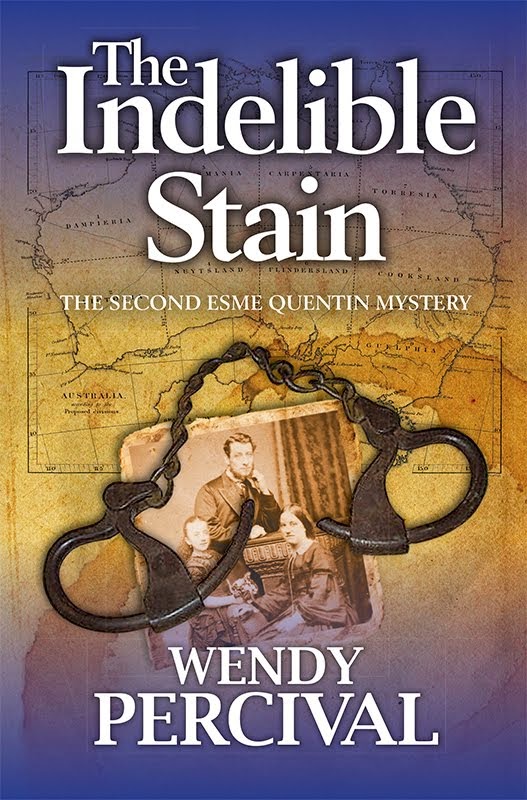
Other names have dropped completely out of usage. The name Rohesia, which I used for a key character in my recent novel, The Indelible Stain, was number nine in the 'most popular' of girl's names around 1250. It's a Latinised form of the name Rose but it's not a name you hear these days (unless you know different, of course!).

The advice when choosing characters' names for your story or novel is never to have two starting with the same letter, so as to avoid confusion. When I wrote Blood-Tied I named Esme's sister Elizabeth without thinking (I seem to have a fixation for names beginning with E for some reason). Before I realised, I'd used the name to demonstrate the particularity of Elizabeth's character - that she never shortened her name to Liz or Lizzie, but always insisted on being known by her full name, Elizabeth. But in the event, rather than having to change it, the error proved serendipitous as it provided me with a very important plot point which I would never have thought of otherwise (and if you don't know what I meant, you'll have to read the book to find out!).

So, on that note, if you'll excuse me - I'd better get back to consulting my Oxford Concise Dictionary of First Names.


*****************************************************
 
 
If you're a writer, how do you choose your characters' names? Do you, like me, need to know what they are at the outset or do they come to you later in the draft?
 
And what about surnames? Do you stick a pin in the phone book? Do you scan the cast lists in the Radio Times?
 
Do you have any good tips for choosing names? Please do share them in the comments box below.


Monday, 22 December 2014

Christmas secrets...

One Christmas when we were children, my sister and I unknowingly bought each other the same Christmas present. When we opened them up on Christmas morning everyone thought it a great hoot that we'd both had the same idea (an oil painting-by-numbers kit, in case you're wondering!) but I remember feeling disappointed without understanding why, as I was quite happy to have a painting kit for myself.

It's only now as I think back that it must have been the familiarity of the present which somehow took the edge off the element of the 'secret surprise' which has always been an exciting part of Christmas. I think it must be the mystery writer in me!

This month, Jo Barton, on her book-blog Jaffareadstoo, has invited a number of authors to share their memories, secrets and favourite things about Christmas. I was delighted to be asked to join in the fun.

So why not drop in on her blog, read about my Christmas thoughts and check out the other authors and their books at the same time. There are give-aways too, including a copy of The Indelible Stain.

Meanwhile, let me take the opportunity to wish you all  
A Merry Christmas

and a

Happy New Year


Thursday, 11 December 2014

Mentioned in dispatches

It was the highlight of a particularly difficult week (husband/heart bypass/complications/long story) when I found out that The Indelible Stain was one of the books chosen for the Editor's Choice in The Bookseller's first ever Independent Author Review.

It was thanks to fellow author Alison Morton that I heard the news and learnt that her book Successio had also been listed, as well as those of three other SilverWood authors - Lily Forbes's memoir Growing Up Under the Mango Tree , Elisabeth Marrion's historical novel Liverpool Connection and Thomas Saunders's autobiography Getting a Life

In the introduction to her review, Caroline Sanderson said the 18 books she'd chosen represented some of the best available, praised the quality of editing and presentation, and declared them to be "written with a flair equal to anything on the list of a traditional publishing house".

In the subsequent #FutureChat on Twitter, the subject of professionalism amongst indie authors was discussed and the importance of producing a quality book.

In the comments afterwards, author Jane Steen made the point that it would be nice to get to the stage where books in general could be judged as "good books" without the need to make the distinction between "trad" and "indie".

I'm sure that day will come eventually. After all, as Alison Morton said during the chat, it's readers who ultimately are the judges. Invariably they care little about which publishing camp the book comes from, so long as they've enjoyed reading it!


(P.S. And in case you're wondering - sorted/on the mend/home soon)

Monday, 20 October 2014

Inspired by mysteries

My online friend and fellow writer Georgia Rose commented, after reading my Family History Secrets blog, that I must have endless patience to do all the research involved.

I had to admit that it's as much to do with addiction as it is perseverance! Plus, being as my Esme Quentin Mysteries are inspired by genealogy, any trawl I do has the added incentive of me inadvertently stumbling upon a  brilliant plot idea!

Georgia confessed she'd be frustrated if she couldn't find out what she wanted and it's true that it's disappointing when I hit the proverbial brick wall and have to abandon a trail without achieving a result.

But there's always another mystery on the list to investigate. Or, as new records are being made available all the time, I might return to those questions I've not yet answered to see if information has come to light since I last searched which might give me that longed-for breakthrough.

Over the years I've discovered the answers to numerous intriguing questions and, although some remain stubbornly elusive, I'm hopeful that one day I'll uncover the truth about those too.

Questions such as:
  • What happened to my great-grandfather when he 'disappeared' after the 1881 census?
  • Why did my great-aunt run away from home in 1904, aged just 16, and tell her employers she had no family?
  • Who was the mysterious spinster to whom my husband's ancestor secretly left his estate and not to his wife?
  • Why did my husband's great-great grandparents travel to Australia in 1868 and why did they not take their children with them?
  • Who was the father of my illegitimate great-grandfather?
  • Who was the mysterious half-brother to my great-grandfather who I discovered on someone else's family tree?
  • What happened to my great-great-grandmother when she disappeared, leaving her illegitimate son behind with her parents?
  • What happened to my husband's ancestor after he was convicted of theft in 1831 and sentenced to 14 years transportation? 

Why not pop over to my familyhistorysecrets blog and find out which of these mysteries I've solved and which I'm still working on? 

And if you have your own family mysteries, either solved or unsolved, I'd love to hear about them.


Monday, 29 September 2014

And then there was cake!

Some while ago someone posted a photograph on Facebook of individual cupcakes on top of which were little mini-books made of icing.

Yes, this really is a cake!
It was such a fantastic idea that I decided I'd like to do something similar when the new Esme Quentin novel,
The Indelible Stain, was published.

My cake making skills aren't up to anything as detailed as individually made folded mini-books but there are simpler options, which can be just as effective.

And so, this weekend at the official Launch Party, we had a Book Cake!

Set in the middle of the table, it made a striking impression as everyone arrived.

I hadn't realised how far the concept of edible icing had come. There are several companies who have the facility to print a copy of any photograph you care to send them with edible inks on to a thin icing layer.


All set. Now pop open the Champagne!   


The printed image arrives through the post (and, in our case, extremely promptly from Cake Topper Designs) in a sealed polythene bag and, if required, keeps for up to 6 months.


When your cake has been iced and you're ready to position the image (not too early, or it will dry out and crack before you get it in place), you remove it from the bag, carefully lay it on top of the cake and smooth it into place. Brilliant!


Never trust a woman with a glass of bubbly in one hand
and a knife in the other. Especially a crime writer!

When I lifted the knife to make the cut (in true crime fiction style), there were comments that it was a shame to cut it up.
 
Not an idea which persisted for very long, though, once everyone realised they'd then not be able to tuck into the cake underneath...
 
 
...which as the evidence shows, they did (with the rest given out in doggy bags).
 

Many thanks to all those who came along to celebrate, eat cake and buy a book!
 
 
*****************************************************************


And to those who weren't at the launch and want to find out more about The Indelible Stain, click on the image on the left or below for all the details.
 
http://www.wendypercival.co.uk/books/4579785417